

Insights
Market Insights
Bell Australian Small Companies
Author
Tim Johnston, James Nguyen, Scott Hudson
Date
12/11/2026
Sector Coverage
Investment destination Australia: The small cap opportunity
November 2026
Important Information:
This webinar contains information specifically intended for institutional clients, asset consultants, advisers, platforms and researchers, who are professional investors and wholesale clients (as defined in the Corporations Act 2001).
I confirm that I am a professional or wholesale investor as defined by the Corporations Act 2001 and wish to proceed.
Summary
Australia is a compelling place to invest, and Australian small caps are where the opportunity sits today. The structural case rests on AAA sovereign quality, a A$4.77 trillion compulsory retirement pool, a high franked dividend stream, deep ties to Asia, strong population growth and a world-class resource endowment.
We are less enthusiastic about Australian large caps. The ASX200 trades on 17x forward earnings for 6–7% forecast EPS growth, a full price for modest growth in a slowing economy.
Small caps, by contrast, are pricing in a recession we do not expect. The small cap index trades on 15.5x, a 10% discount to large caps, with a higher dividend yield and 26% forecast EPS growth. Earnings growth, dividends and multiple expansion all point the same way.
The structural case for Australia
Australia is an open, high-income developed nation next to the world's fastest-growing region. Real GDP has compounded at 2.6% a year over the past 20 years, and outside the COVID shutdown Australia has not had a recession since 1991. Six structural advantages underpin this record.
Sovereign quality. Australia is one of nine countries rated AAA by all three major agencies, reaffirmed by S&P, Moody's and Fitch between August and October 2026. A strong regulatory framework and common-law legal system give a stable governance backdrop. At c60%, government debt to GDP is at the lower end of the western world, which keeps borrowing costs competitive and leaves fiscal room to respond to shocks.
General government debt (% of GDP, 2025)

Structural capital. The compulsory retirement system holds A$4.77 trillion (June 2026), the world's fourth-largest pool, and drew A$236 billion of contributions in the past year. This sets Australia's fiscal outlook apart from western peers facing unfunded pension liabilities, and provides a steady flow of domestic capital into local assets.
Income and diversification. The franking system supports a high, largely franked dividend stream. The sector mix, heavy in financials and materials with little technology, differs sharply from US-dominated global indices. That matters because emerging market equities no longer do the job they once did for global growth and commodity exposure: the weight of Korea and Taiwan has turned those indices into a bet on AI hardware.
Proximity and ties to Asia. Around 60% of Australian exports go to Asia, and the share is growing. Australia supplies agricultural commodities and a broad suite of minerals, backed by free trade agreements with China, Japan, South Korea, India, Indonesia, Malaysia, Thailand and Hong Kong. Services exports to the region, chiefly education and travel, are also large and feed the migration pipeline.
Population growth. Population is growing at c1.4% a year, underpinning economic growth. Immigration has averaged c275,000 people a year over the past five years, and roughly two-thirds of migrants come from Asia, deepening ties with the region.
Real-asset leverage. Australia holds the world's largest economic resources of gold, iron ore, uranium, zinc and lead, and is the top producer of iron ore and lithium. Mature, stable mining regulation and a highly skilled workforce add to the endowment, and Australian miners and mining contractors now operate globally on the strength of that expertise.
Australia ranks in the global top three for resources in 12 of 14 key commodities:

That endowment positions Australia as a supplier into the mega-trends shaping the global economy over the medium term:

Large caps: a full price for modest growth
The structural case does not make every Australian asset cheap, and we think large caps are fully valued. At face value the cyclical backdrop is uninspiring: GDP growth is 2.1% (vs 3.4% in the US), headline inflation is stubbornly high at 4.0% with core at 3.6%, and most surveys put consumer confidence near decade lows.
The ASX200 has nonetheless been resilient, up 2% calendar year to date, and still trades on 17x forward earnings. That multiple buys forecast EPS growth of only 6–7%, modest against other developed markets.
Returns can only come from three sources: earnings growth, dividends, and a change in the multiple. For large caps, earnings growth is single-digit and a 17x starting multiple leaves little room for expansion in a slowing economy. The dividend stream is real, but on its own it is not a reason to pay up for the index.
“The structural case does not make every Australian asset cheap, and we think large caps are fully valued.”
Small caps: the current opportunity
The market is pricing an Australian recession into small caps, and we do not think one is coming. The small cap index is down 16% calendar year to date while large caps are up 2%.
The economy is softer than 12 months ago, but a recession is not our base case. Unemployment remains a healthy 4.7%. The August reporting season delivered more earnings beats than misses and, more importantly, guidance much better than feared. An economy slowing but holding, against a market pricing in a recession, is the disconnect we want to own.
In more than two decades of investing in Australian equities, we have rarely seen a more compelling entry point. Small caps have been cheaper twice, after the GFC and after COVID, and both times delivered stellar returns. But those moments demanded a leap of faith: the GFC questioned the viability of the banking system, and COVID was without precedent. Today's opportunity asks for no such leap.
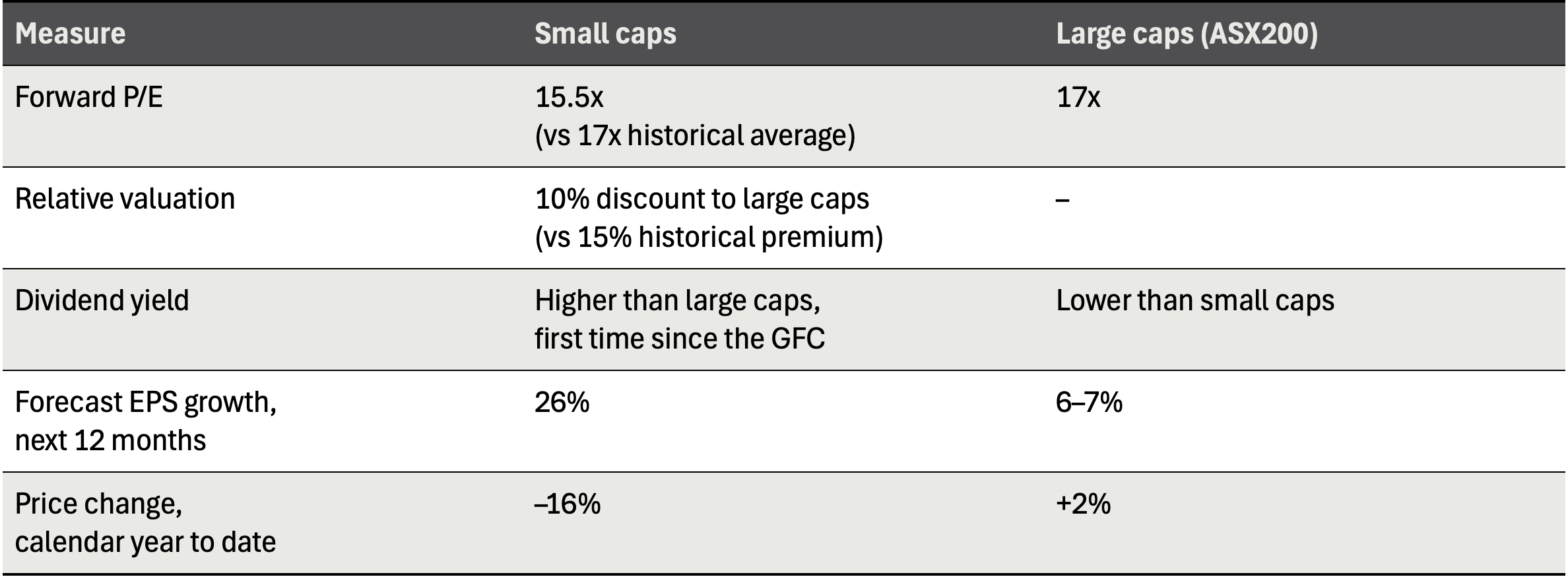
Small caps are cheap on an absolute basis, cheap relative to large caps, and carry yield support. On top of valuation, they offer materially higher earnings growth.
Much of that growth comes from resources and energy, which make up 33% of the small cap index. The sector gives broad exposure to commodities driven by electrification (copper, aluminium, lithium, uranium), geopolitical unrest (oil, refining, rare earths) and US dollar debasement (gold), plus idiosyncratic exposures such as niobium and zircon. This is where Australia's structural resource advantage shows up most directly in listed equities, and the commodity upgrade cycle is driving the earnings.
Of the three sources of return, small caps tick all three: strong earnings growth, a dividend yield now above large caps, and scope for the multiple to re-rate towards its historical level and its usual premium.
What would change our view
Our case depends on Australia avoiding recession. A material rise in unemployment from 4.7%, or a reporting season where guidance disappoints, would challenge it. Sticky inflation at 4.0% also limits how quickly rates can ease to support the domestic economy.
The resources-led earnings growth in small caps depends on the commodity upgrade cycle holding. A sharp reversal in commodity prices would cut forecast EPS growth and remove one of the three sources of return.
Conclusion
Australia's structural advantages make it a compelling long-term investment destination, but the entry point matters. Large caps price in the good news at 17x for 6–7% growth. Small caps price in a recession we do not expect, at 15.5x for 26% growth with a higher yield, and that is where we see the opportunity.
Important information
This document has been prepared by Bell Asset Management Limited (BAM) ABN 84 092 278 647, AFSL 231091 and is provided solely for information only purposes. This document does not take into consideration the investment objectives, financial circumstances or needs of any particular recipient – it contains general information only. This document does not take into account a recipient’s investment objectives, particular needs or financial situation. It is general information only and should not be considered as investment advice and should not be relied on as an investment recommendation. Before acting on any information, recipients should consider the appropriateness of it and of the relevant product or strategy having regard to their investment objectives, particular needs and financial situation. In particular, recipients should seek independent financial, legal and taxation advice and read the relevant disclosure document or agreement prior to acquiring a financial product or strategy.
No representation or warranty, express or implied, is made as to the accuracy, completeness or reasonableness of any assumption contained in this presentation. To the maximum extent permitted by law, none of BAM and its directors, employees or agents accepts any liability for any loss arising, including from negligence, from the use of this document or its contents nor does BAM assume any obligation to update the information. BAM has made every effort to ensure the accuracy and currency of the information contained in this document; however, no warranty is given as to the accuracy or reliability of the information. An investment with BAM is subject to risk including loss of capital and no assurance is given that a BAM product or strategy will achieve its investment objective. Past performance is no guarantee of future performance.
Source: Bell Asset Management as at 4 November 2026
Important Information:
This video contains information specifically intended for institutional clients, asset consultants, advisers, platforms and researchers, who are professional investors and wholesale clients (as defined in the Corporations Act 2001).
I confirm that I am a professional or wholesale investor as defined by the Corporations Act 2001 and wish to proceed.
Summary
Australia is a compelling place to invest, and Australian small caps are where the opportunity sits today. The structural case rests on AAA sovereign quality, a A$4.77 trillion compulsory retirement pool, a high franked dividend stream, deep ties to Asia, strong population growth and a world-class resource endowment.
We are less enthusiastic about Australian large caps. The ASX200 trades on 17x forward earnings for 6–7% forecast EPS growth, a full price for modest growth in a slowing economy.
Small caps, by contrast, are pricing in a recession we do not expect. The small cap index trades on 15.5x, a 10% discount to large caps, with a higher dividend yield and 26% forecast EPS growth. Earnings growth, dividends and multiple expansion all point the same way.
The structural case for Australia
Australia is an open, high-income developed nation next to the world's fastest-growing region. Real GDP has compounded at 2.6% a year over the past 20 years, and outside the COVID shutdown Australia has not had a recession since 1991. Six structural advantages underpin this record.
Sovereign quality. Australia is one of nine countries rated AAA by all three major agencies, reaffirmed by S&P, Moody's and Fitch between August and October 2026. A strong regulatory framework and common-law legal system give a stable governance backdrop. At c60%, government debt to GDP is at the lower end of the western world, which keeps borrowing costs competitive and leaves fiscal room to respond to shocks.
General government debt (% of GDP, 2025)
Structural capital. The compulsory retirement system holds A$4.77 trillion (June 2026), the world's fourth-largest pool, and drew A$236 billion of contributions in the past year. This sets Australia's fiscal outlook apart from western peers facing unfunded pension liabilities, and provides a steady flow of domestic capital into local assets.
Income and diversification. The franking system supports a high, largely franked dividend stream. The sector mix, heavy in financials and materials with little technology, differs sharply from US-dominated global indices. That matters because emerging market equities no longer do the job they once did for global growth and commodity exposure: the weight of Korea and Taiwan has turned those indices into a bet on AI hardware.
Proximity and ties to Asia. Around 60% of Australian exports go to Asia, and the share is growing. Australia supplies agricultural commodities and a broad suite of minerals, backed by free trade agreements with China, Japan, South Korea, India, Indonesia, Malaysia, Thailand and Hong Kong. Services exports to the region, chiefly education and travel, are also large and feed the migration pipeline.
Population growth. Population is growing at c1.4% a year, underpinning economic growth. Immigration has averaged c275,000 people a year over the past five years, and roughly two-thirds of migrants come from Asia, deepening ties with the region.
Real-asset leverage. Australia holds the world's largest economic resources of gold, iron ore, uranium, zinc and lead, and is the top producer of iron ore and lithium. Mature, stable mining regulation and a highly skilled workforce add to the endowment, and Australian miners and mining contractors now operate globally on the strength of that expertise.
Australia ranks in the global top three for resources in 12 of 14 key commodities:
That endowment positions Australia as a supplier into the mega-trends shaping the global economy over the medium term:
Large caps: a full price for modest growth
The structural case does not make every Australian asset cheap, and we think large caps are fully valued. At face value the cyclical backdrop is uninspiring: GDP growth is 2.1% (vs 3.4% in the US), headline inflation is stubbornly high at 4.0% with core at 3.6%, and most surveys put consumer confidence near decade lows.
The ASX200 has nonetheless been resilient, up 2% calendar year to date, and still trades on 17x forward earnings. That multiple buys forecast EPS growth of only 6–7%, modest against other developed markets.
Returns can only come from three sources: earnings growth, dividends, and a change in the multiple. For large caps, earnings growth is single-digit and a 17x starting multiple leaves little room for expansion in a slowing economy. The dividend stream is real, but on its own it is not a reason to pay up for the index.
“The structural case does not make every Australian asset cheap, and we think large caps are fully valued.”
Small caps: the current opportunity
The market is pricing an Australian recession into small caps, and we do not think one is coming. The small cap index is down 16% calendar year to date while large caps are up 2%.
The economy is softer than 12 months ago, but a recession is not our base case. Unemployment remains a healthy 4.7%. The August reporting season delivered more earnings beats than misses and, more importantly, guidance much better than feared. An economy slowing but holding, against a market pricing in a recession, is the disconnect we want to own.
In more than two decades of investing in Australian equities, we have rarely seen a more compelling entry point. Small caps have been cheaper twice, after the GFC and after COVID, and both times delivered stellar returns. But those moments demanded a leap of faith: the GFC questioned the viability of the banking system, and COVID was without precedent. Today's opportunity asks for no such leap.
Small caps are cheap on an absolute basis, cheap relative to large caps, and carry yield support. On top of valuation, they offer materially higher earnings growth.
Much of that growth comes from resources and energy, which make up 33% of the small cap index. The sector gives broad exposure to commodities driven by electrification (copper, aluminium, lithium, uranium), geopolitical unrest (oil, refining, rare earths) and US dollar debasement (gold), plus idiosyncratic exposures such as niobium and zircon. This is where Australia's structural resource advantage shows up most directly in listed equities, and the commodity upgrade cycle is driving the earnings.
Of the three sources of return, small caps tick all three: strong earnings growth, a dividend yield now above large caps, and scope for the multiple to re-rate towards its historical level and its usual premium.
What would change our view
Our case depends on Australia avoiding recession. A material rise in unemployment from 4.7%, or a reporting season where guidance disappoints, would challenge it. Sticky inflation at 4.0% also limits how quickly rates can ease to support the domestic economy.
The resources-led earnings growth in small caps depends on the commodity upgrade cycle holding. A sharp reversal in commodity prices would cut forecast EPS growth and remove one of the three sources of return.
Conclusion
Australia's structural advantages make it a compelling long-term investment destination, but the entry point matters. Large caps price in the good news at 17x for 6–7% growth. Small caps price in a recession we do not expect, at 15.5x for 26% growth with a higher yield, and that is where we see the opportunity.
Important information
This document has been prepared by Bell Asset Management Limited (BAM) ABN 84 092 278 647, AFSL 231091 and is provided solely for information only purposes. This document does not take into consideration the investment objectives, financial circumstances or needs of any particular recipient – it contains general information only. This document does not take into account a recipient’s investment objectives, particular needs or financial situation. It is general information only and should not be considered as investment advice and should not be relied on as an investment recommendation. Before acting on any information, recipients should consider the appropriateness of it and of the relevant product or strategy having regard to their investment objectives, particular needs and financial situation. In particular, recipients should seek independent financial, legal and taxation advice and read the relevant disclosure document or agreement prior to acquiring a financial product or strategy.
No representation or warranty, express or implied, is made as to the accuracy, completeness or reasonableness of any assumption contained in this presentation. To the maximum extent permitted by law, none of BAM and its directors, employees or agents accepts any liability for any loss arising, including from negligence, from the use of this document or its contents nor does BAM assume any obligation to update the information. BAM has made every effort to ensure the accuracy and currency of the information contained in this document; however, no warranty is given as to the accuracy or reliability of the information. An investment with BAM is subject to risk including loss of capital and no assurance is given that a BAM product or strategy will achieve its investment objective. Past performance is no guarantee of future performance.
Source: Bell Asset Management as at 4 November 2026
Summary
Australia is a compelling place to invest, and Australian small caps are where the opportunity sits today. The structural case rests on AAA sovereign quality, a A$4.77 trillion compulsory retirement pool, a high franked dividend stream, deep ties to Asia, strong population growth and a world-class resource endowment.
We are less enthusiastic about Australian large caps. The ASX200 trades on 17x forward earnings for 6–7% forecast EPS growth, a full price for modest growth in a slowing economy.
Small caps, by contrast, are pricing in a recession we do not expect. The small cap index trades on 15.5x, a 10% discount to large caps, with a higher dividend yield and 26% forecast EPS growth. Earnings growth, dividends and multiple expansion all point the same way.
The structural case for Australia
Australia is an open, high-income developed nation next to the world's fastest-growing region. Real GDP has compounded at 2.6% a year over the past 20 years, and outside the COVID shutdown Australia has not had a recession since 1991. Six structural advantages underpin this record.
Sovereign quality. Australia is one of nine countries rated AAA by all three major agencies, reaffirmed by S&P, Moody's and Fitch between August and October 2026. A strong regulatory framework and common-law legal system give a stable governance backdrop. At c60%, government debt to GDP is at the lower end of the western world, which keeps borrowing costs competitive and leaves fiscal room to respond to shocks.
General government debt (% of GDP, 2025)
Structural capital. The compulsory retirement system holds A$4.77 trillion (June 2026), the world's fourth-largest pool, and drew A$236 billion of contributions in the past year. This sets Australia's fiscal outlook apart from western peers facing unfunded pension liabilities, and provides a steady flow of domestic capital into local assets.
Income and diversification. The franking system supports a high, largely franked dividend stream. The sector mix, heavy in financials and materials with little technology, differs sharply from US-dominated global indices. That matters because emerging market equities no longer do the job they once did for global growth and commodity exposure: the weight of Korea and Taiwan has turned those indices into a bet on AI hardware.
Proximity and ties to Asia. Around 60% of Australian exports go to Asia, and the share is growing. Australia supplies agricultural commodities and a broad suite of minerals, backed by free trade agreements with China, Japan, South Korea, India, Indonesia, Malaysia, Thailand and Hong Kong. Services exports to the region, chiefly education and travel, are also large and feed the migration pipeline.
Population growth. Population is growing at c1.4% a year, underpinning economic growth. Immigration has averaged c275,000 people a year over the past five years, and roughly two-thirds of migrants come from Asia, deepening ties with the region.
Real-asset leverage. Australia holds the world's largest economic resources of gold, iron ore, uranium, zinc and lead, and is the top producer of iron ore and lithium. Mature, stable mining regulation and a highly skilled workforce add to the endowment, and Australian miners and mining contractors now operate globally on the strength of that expertise.
Australia ranks in the global top three for resources in 12 of 14 key commodities:
That endowment positions Australia as a supplier into the mega-trends shaping the global economy over the medium term:
Large caps: a full price for modest growth
The structural case does not make every Australian asset cheap, and we think large caps are fully valued. At face value the cyclical backdrop is uninspiring: GDP growth is 2.1% (vs 3.4% in the US), headline inflation is stubbornly high at 4.0% with core at 3.6%, and most surveys put consumer confidence near decade lows.
The ASX200 has nonetheless been resilient, up 2% calendar year to date, and still trades on 17x forward earnings. That multiple buys forecast EPS growth of only 6–7%, modest against other developed markets.
Returns can only come from three sources: earnings growth, dividends, and a change in the multiple. For large caps, earnings growth is single-digit and a 17x starting multiple leaves little room for expansion in a slowing economy. The dividend stream is real, but on its own it is not a reason to pay up for the index.
“The structural case does not make every Australian asset cheap, and we think large caps are fully valued.”
Small caps: the current opportunity
The market is pricing an Australian recession into small caps, and we do not think one is coming. The small cap index is down 16% calendar year to date while large caps are up 2%.
The economy is softer than 12 months ago, but a recession is not our base case. Unemployment remains a healthy 4.7%. The August reporting season delivered more earnings beats than misses and, more importantly, guidance much better than feared. An economy slowing but holding, against a market pricing in a recession, is the disconnect we want to own.
In more than two decades of investing in Australian equities, we have rarely seen a more compelling entry point. Small caps have been cheaper twice, after the GFC and after COVID, and both times delivered stellar returns. But those moments demanded a leap of faith: the GFC questioned the viability of the banking system, and COVID was without precedent. Today's opportunity asks for no such leap.
Small caps are cheap on an absolute basis, cheap relative to large caps, and carry yield support. On top of valuation, they offer materially higher earnings growth.
Much of that growth comes from resources and energy, which make up 33% of the small cap index. The sector gives broad exposure to commodities driven by electrification (copper, aluminium, lithium, uranium), geopolitical unrest (oil, refining, rare earths) and US dollar debasement (gold), plus idiosyncratic exposures such as niobium and zircon. This is where Australia's structural resource advantage shows up most directly in listed equities, and the commodity upgrade cycle is driving the earnings.
Of the three sources of return, small caps tick all three: strong earnings growth, a dividend yield now above large caps, and scope for the multiple to re-rate towards its historical level and its usual premium.
What would change our view
Our case depends on Australia avoiding recession. A material rise in unemployment from 4.7%, or a reporting season where guidance disappoints, would challenge it. Sticky inflation at 4.0% also limits how quickly rates can ease to support the domestic economy.
The resources-led earnings growth in small caps depends on the commodity upgrade cycle holding. A sharp reversal in commodity prices would cut forecast EPS growth and remove one of the three sources of return.
Conclusion
Australia's structural advantages make it a compelling long-term investment destination, but the entry point matters. Large caps price in the good news at 17x for 6–7% growth. Small caps price in a recession we do not expect, at 15.5x for 26% growth with a higher yield, and that is where we see the opportunity.
Important information
This document has been prepared by Bell Asset Management Limited (BAM) ABN 84 092 278 647, AFSL 231091 and is provided solely for information only purposes. This document does not take into consideration the investment objectives, financial circumstances or needs of any particular recipient – it contains general information only. This document does not take into account a recipient’s investment objectives, particular needs or financial situation. It is general information only and should not be considered as investment advice and should not be relied on as an investment recommendation. Before acting on any information, recipients should consider the appropriateness of it and of the relevant product or strategy having regard to their investment objectives, particular needs and financial situation. In particular, recipients should seek independent financial, legal and taxation advice and read the relevant disclosure document or agreement prior to acquiring a financial product or strategy.
No representation or warranty, express or implied, is made as to the accuracy, completeness or reasonableness of any assumption contained in this presentation. To the maximum extent permitted by law, none of BAM and its directors, employees or agents accepts any liability for any loss arising, including from negligence, from the use of this document or its contents nor does BAM assume any obligation to update the information. BAM has made every effort to ensure the accuracy and currency of the information contained in this document; however, no warranty is given as to the accuracy or reliability of the information. An investment with BAM is subject to risk including loss of capital and no assurance is given that a BAM product or strategy will achieve its investment objective. Past performance is no guarantee of future performance.
Source: Bell Asset Management as at 4 November 2026


